Astrophotography is planning, patience, and hours of work to pull out what the eye cannot see. Every frame is earned. Dean shoots the night sky from some of the darkest corners of New Zealand.
It started the way a lot of things start for Dean. Chasing the southern lights. Aurora photography taught him to read darkness, weather, and timing in a completely different way. But the more time he spent under dark skies, the more he noticed what was above the glow. The Milky Way. The detail. The sheer scale of what was up there, invisible to the naked eye but waiting to be pulled out of a long exposure.
Then came a workshop with astrophotographer Rachel Roberts, and everything changed. The technical precision, the stacking, the processing. It was a completely different discipline to anything Dean had done before. Not something you can stumble into a good result with. Every single part of the process is deliberate, from planning the shot weeks in advance to the many hours of editing that extract colour and detail you did not even know was there.
The week before Rachel's workshop, Dean went out every single night. No waiting for perfect conditions, no putting it off. Just shooting, trying to push as far as he could before learning how to do it properly. This shot from Punakaiki came out of one of those nights. A beautiful light fog sat over the sky and made the stars glow in a way he had not seen before.
Looking back, he could do a lot better now. But that is the point. Astro week was about building the discipline and putting in the reps. The workshop would teach the technique, but the habit of getting out there no matter what had to come first.
Punakaiki
Akaroa
The first shoot after the workshop with Rachel was in Akaroa. Dean and Nicole had a trip away, and he wanted to put everything he had just learned to the test. This would be his first ever multirow panorama. Multiple rows of frames stitched together to capture the full arc of the Milky Way from horizon to horizon.
It was an incredibly windy night. The kind of wind that makes you question whether the tripod is going to hold. But Dean was thrilled to see the setup was stable enough to produce sharp stars across every panel. The result was proof that the workshop had landed. The technique worked. The planning worked. And the hours of processing pulled out a sky that no one standing in that wind could have seen with their own eyes.
The first comet Dean ever photographed came with no guarantees. He had no idea if it would be visible to the eye, had never pointed a camera at one before, and only roughly knew where in the sky to look. He just went out and tried.
The result sits over the Cobden tiphead at sunset. Well composed, clean, and something Dean considers a bit of an icon in his collection. Not bad for pointing a camera at something you have never seen before and hoping for the best.
Cobden Tiphead
Full Moon
Dean's first real attempt at a moon shot. The composition came together nicely with the tree framing the right side of the frame, but the challenge was the exposure. A full moon is bright enough to blow out everything around it if you are not careful, and getting the balance right between the glow and the surrounding detail is harder than it looks.
It is a completely different problem to the rest of astrophotography. Instead of pulling faint detail out of darkness, you are trying to hold back something that wants to overpower the entire image. A different kind of fight, but just as satisfying to get right.
The Tekapo panorama is one of the most technically accomplished shots in Dean's collection. His first single-row astro panorama, with even a hint of aurora creeping into the frame. But the photo matters for reasons that have nothing to do with technique.
This trip was to celebrate Nicole finishing her last round of chemotherapy. Dean took her and her parents to Tekapo, where they had a place with a hot tub under some of the darkest skies in New Zealand. He set up the camera and captured the Milky Way arching over the scene while the people he loves most were nearby.
Some photos are about what you can pull out of the sky. This one is about what was happening on the ground.
Tekapo
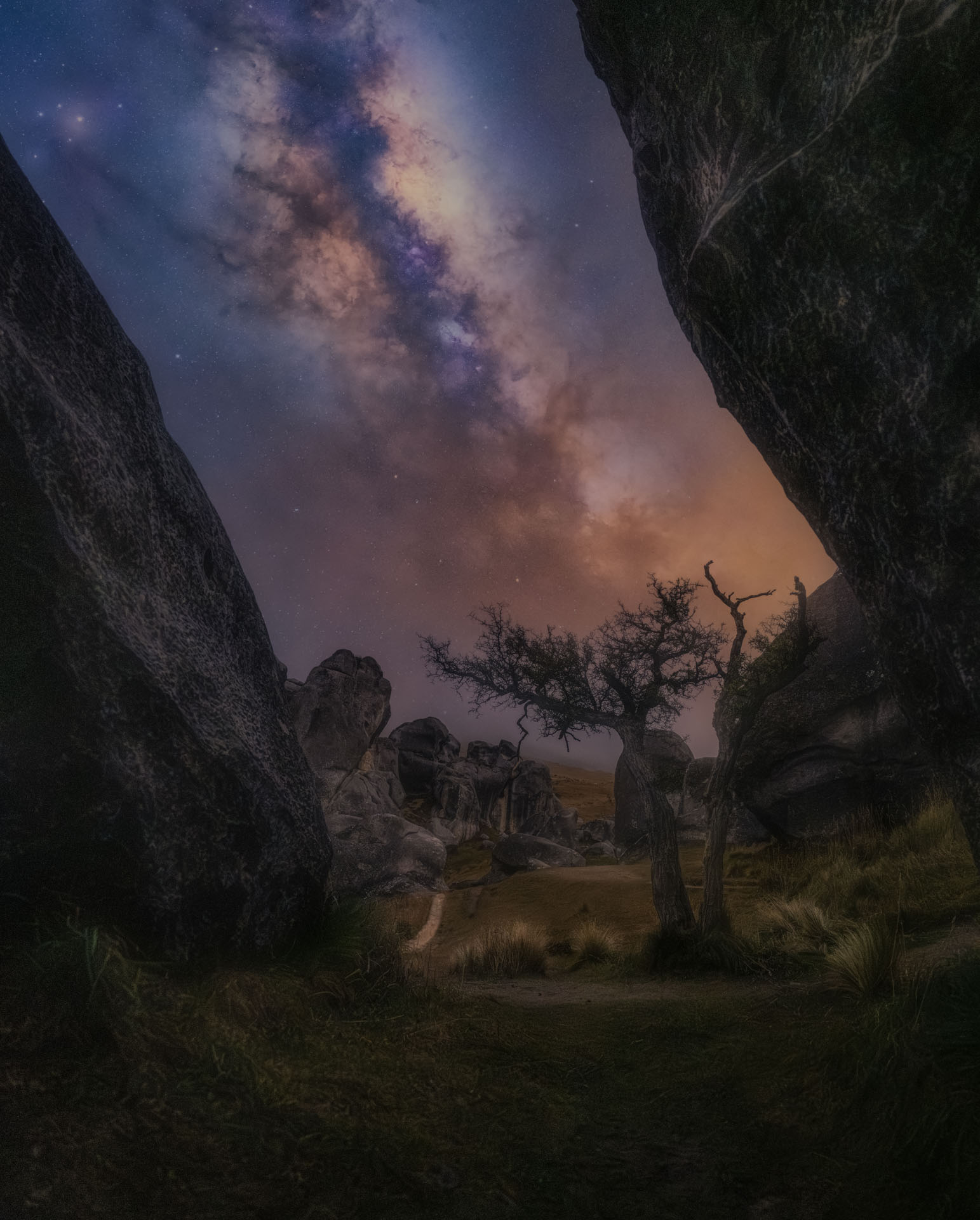
Castle Hill
This was thirty minutes before the big panorama. Dean and Nicole found a spot wedged between two converging rock formations at Castle Hill, a natural frame that made the whole scene feel like peering out of a cave. The Milky Way lined up perfectly between the rocks, pointing straight toward a lone tree in the distance. He had tried a version of this shot during Matariki 2024 and knew he could do it better.
It was slightly sketchy. Sheets of rock had clearly peeled away from the formations above and shattered on the ground right beside them. Not the kind of place you want to spend more time than you need to. But the composition was too good to walk away from.
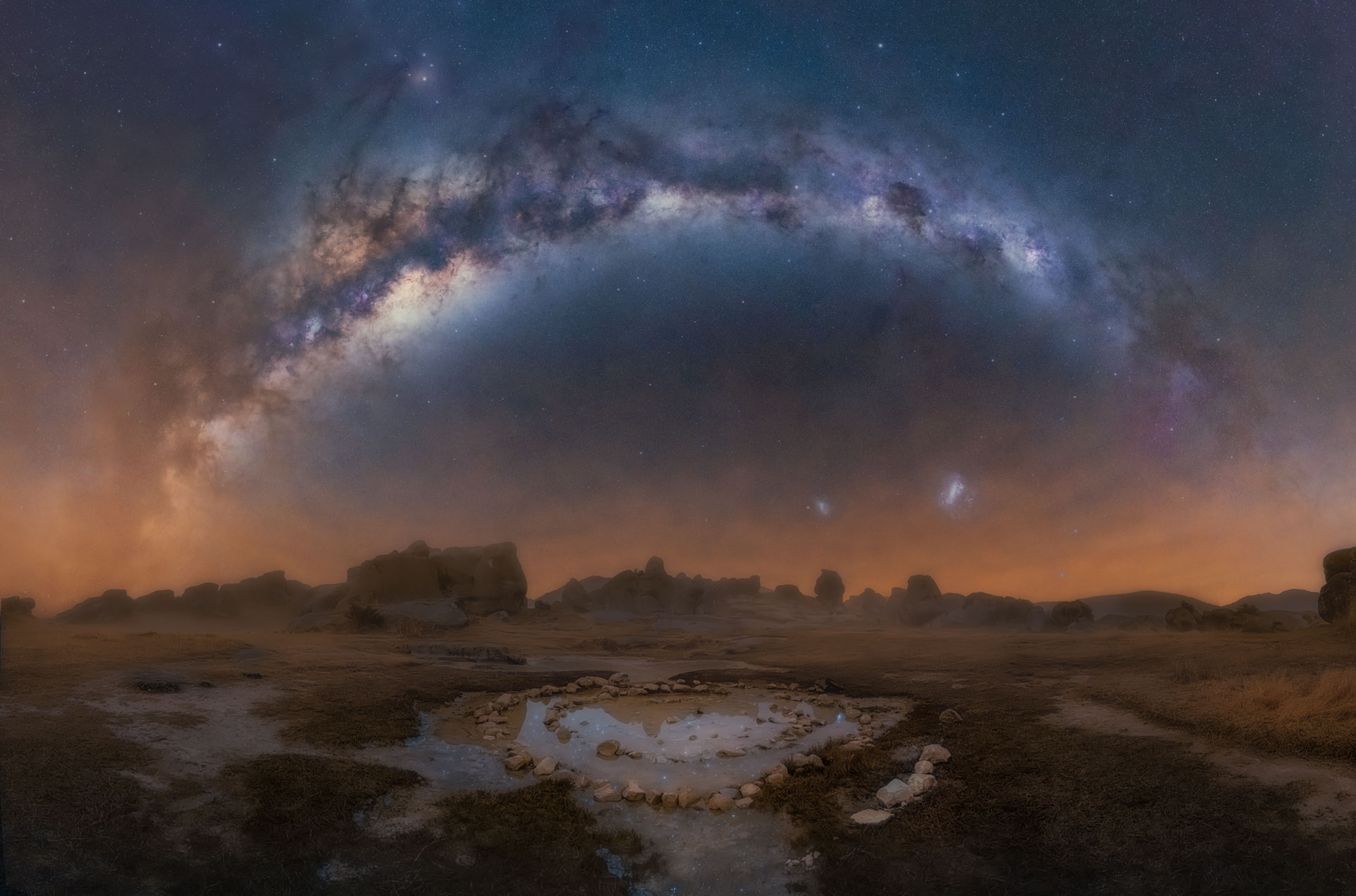
Thirty minutes after squeezing between the rocks, Dean set up for the shot he had come for. The swirl rock pond at Castle Hill, dead centre of the frame, with the Milky Way arching overhead. The composition was planned weeks in advance. The fog was not.
It rolled in and out so fast all night that getting a consistently foggy foreground across every panel of the panorama felt like a coin flip. Some frames had thick fog, others were clear, and the window between them was minutes at best. But it came together. Not a single soul in sight, just the rocks, the fog, and a sky that no one standing there could have seen with their own eyes. One of those nights where everything lined up.
Castle Hill
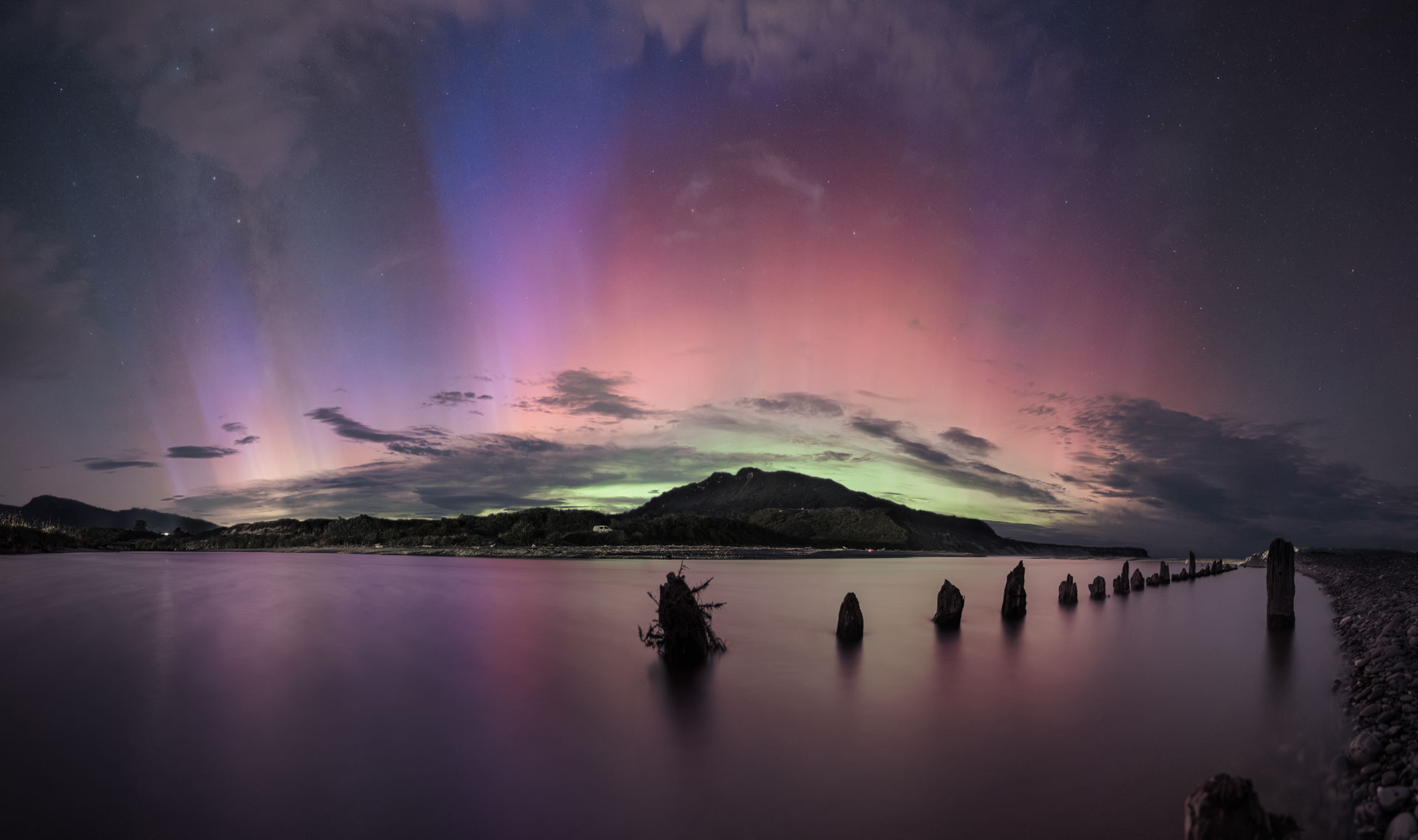
This night had one of the brightest auroras Dean had ever seen, and something he had never really encountered before. Tall Blue Rays. Columns of blue light extending vertically through the display. A rare phenomenon for aurora this far north in New Zealand, and not something you want to sleep through.
The well known pier stumps at Rapahoe were the obvious choice for foreground, but it depended on where the river was running. Some nights the river sits right against the stumps and kills the composition. Dean pulled up, saw the aurora blazing and the river sitting well away from the stumps, and knew he had the shot. The brightest aurora he had ever seen, right on the Coast.
More aurora photography in the aurora section.
Rapahoe
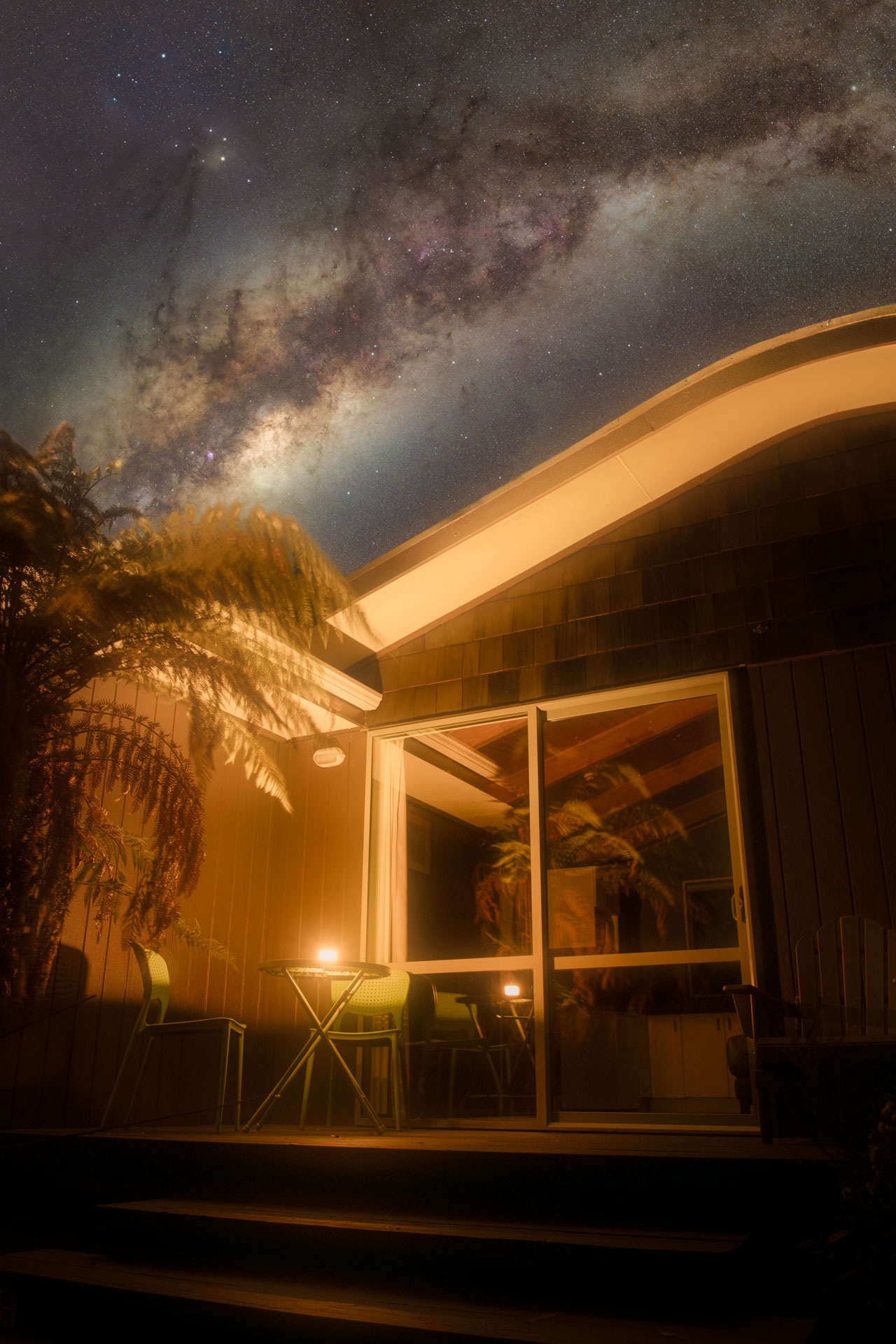
Goldfield Suites
Andy and Jolene have booked Dean in every single year since he started out, and this one came out of the Small Business Promo Package he puts together for them. Goldfield Suites sits up Rutherglen Road, where the darkness is a given. Genuinely beautiful, genuinely dark skies, exactly the kind of spot that nightscapes were made for.
Getting to shoot something like this for two people who have supported him from the very beginning made this one particularly satisfying to deliver.
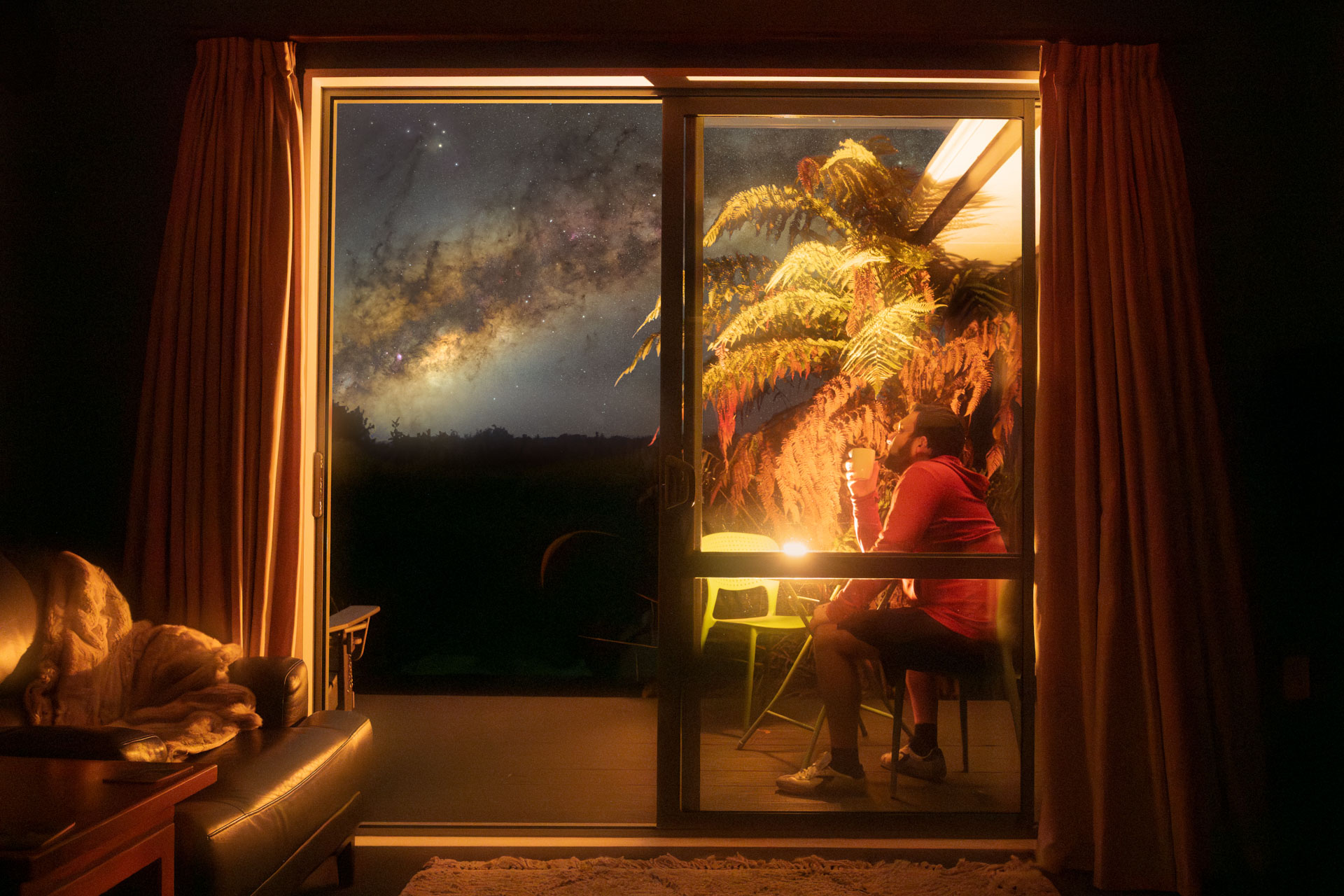
This one was deliberate from the start. Dean wanted to frame the shot as though someone was relaxing outside with a cuppa, watching the stars roll past through the ranch slider. He brought along a candle for a bit of ambient light, and it ended up doing most of the heavy lifting for the atmosphere.
The result is cosy and peaceful in a way that pure nightscapes rarely are. Less about the vastness of the sky, more about what it feels like to sit somewhere and simply look up at it.
Goldfield Suites
Cowboys Paradise, Milltown
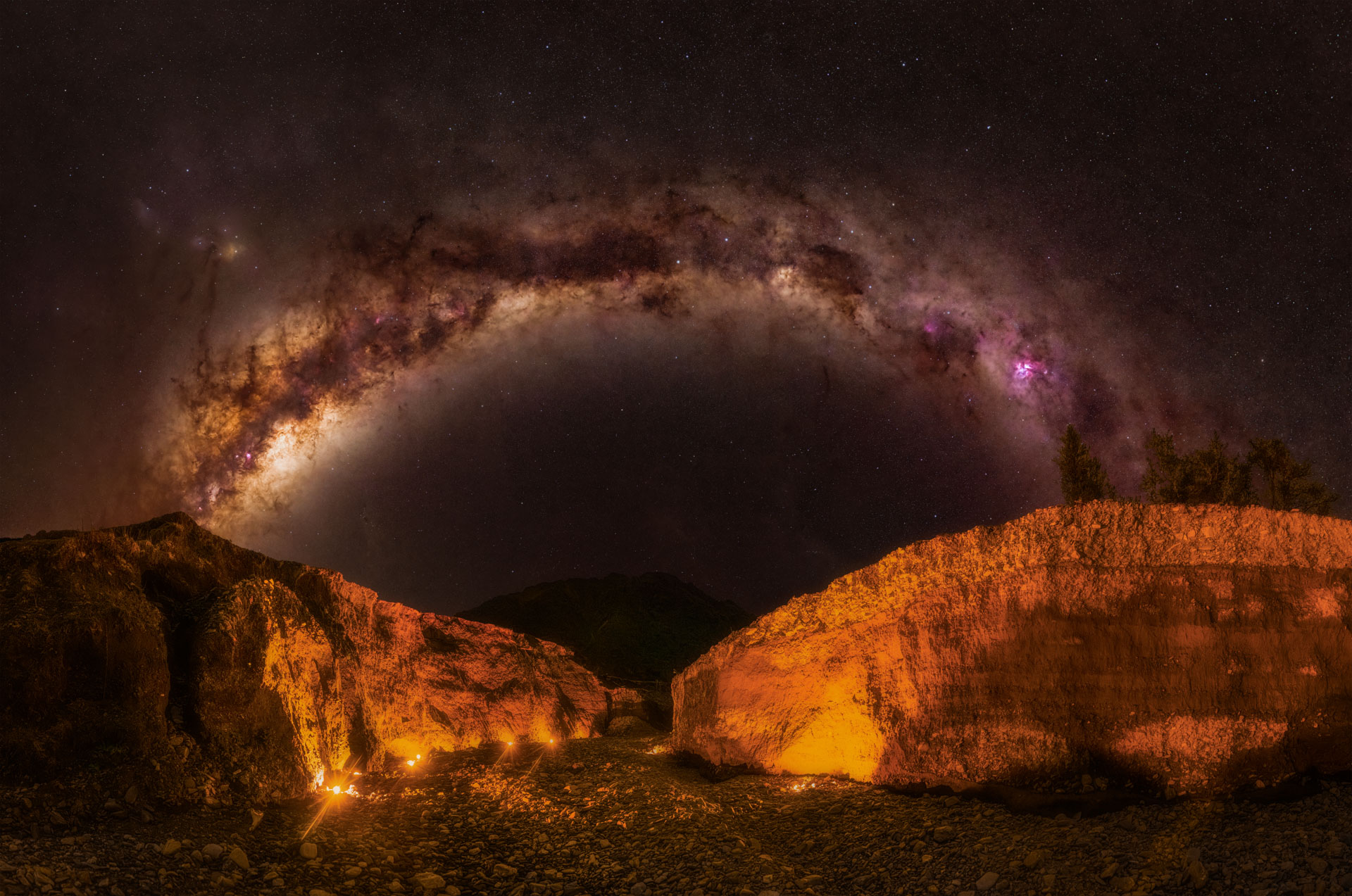
Down in Milltown by Lake Kaniere sits a ravine carved out over time by flood after flood. It is normally bone dry, a genuine oddity on the West Coast, and paired with proper dark skies it makes for a striking piece of ground to shoot into.
On the way down, Dean had the idea to grab a handful of tealight candles and use them to paint light through the ravine while the Milky Way arched overhead. It was a bit of a punt on the drive down, but it paid off. One of those small, spontaneous ideas that came together better than expected.
Normal photography has room for happy accidents. A burst of light, a moment caught at just the right time, a composition that falls into place. Astrophotography does not work that way. The end result is built entirely on planning, technical precision, and the many hours of editing it takes to extract detail and colour that you did not even know was there. Every decision is deliberate. Every step matters. And when all of that hard work comes together into a single image, the feeling is unlike anything else in photography.


If you are after astrophotography prints, want to learn how to shoot the night sky, or just want to talk about what is up there, get in touch.